Wednesday, February 6, 2008


Tuesday, February 5, 2008
Digital Ethics
Blogging is a very public activity. Anything that gets posted on the internet stays there. Forever. Deleting a post simply removes it from the blog it was posted to. Copies of the post may exist scattered all over the internet. I have come across posts from my students on blogs as far away as Sweden! That is why we are being so careful to respect your privacy and using first names only. We do not use pictures of ourselves. If you really want a graphic image associated with your posting use an avatar -- a picture of something that represents you but IS NOT of you.
Here are a few videos that illustrate some of what I want you to think about:
Four suggestions:
Look over the guidelines and add the ones you like in the comments section below this post. We'll be using the one's I highlighted above as a basis for how we will use our blog.
Cheers,
Mr. K.
Here are a few videos that illustrate some of what I want you to think about:
Four suggestions:
- Students using blogs are expected to treat blogspaces as classroom spaces. Speech that is inappropriate for class is not appropriate for our blog. While we encourage you to engage in debate and conversation with other bloggers, we also expect that you will conduct yourself in a manner reflective of a representative of this school.
- Never EVER EVER give out or record personal information on our blog. Our blog exists as a public space on the Internet. Don’t share anything that you don’t want the world to know. For your safety, be careful what you say, too. Don’t give out your phone number or home address. This is particularly important to remember if you have a personal online journal or blog elsewhere.
- Again, your blog is a public space. And if you put it on the Internet, odds are really good that it will stay on the Internet. Always. That means ten years from now when you are looking for a job, it might be possible for an employer to discover some really hateful and immature things you said when you were younger and more prone to foolish things. Be sure that anything you write you are proud of. It can come back to haunt you if you don’t.
- Never link to something you haven’t read. While it isn’t your job to police the Internet, when you link to something, you should make sure it is something that you really want to be associated with. If a link contains material that might be creepy or make some people uncomfortable, you should probably try a different source.
Look over the guidelines and add the ones you like in the comments section below this post. We'll be using the one's I highlighted above as a basis for how we will use our blog.
Cheers,
Mr. K.
Degrees to Radians
Today, Mr. K firstly stated that we could do somethings to help enhance our blog such as downloading smartboard software to make our blog better by easily retrieving useful images such a slides from class. We can also view the class slides via pdf files on slideshow via download. Anyways, back to the class
He started talking about converting degree's and radians and how to grasp the concept. He first showed us an equilateral triangle, in slide 3, and how all it's angles were of 60° . He then displayed the concept of pressing down on the triangle, forcing one of the angles to be a little less than 60 degrees. That is practically a Radian. A radian is around 57°.
He then showed us an equation that you can view in the slides. The equation was D/180° = R/Pi where D is an angle in degrees and R is an angle in Radians.
In most cases, If D or R is known, one or the other variables can be found via cross multiplying.
In the slide 5, you will find that we converted 25° into Radians. Found after cross multiplying or taking the long method of balancing both sides until one variable is isolated, we will find that 25° is 5pi/36° Radian.
Note that when you do the equation (25°/180° = theta/pi) and you don't indicate the degree units, the 180 will be seen as 180 RADIANS. So it is important to show the units.
On the slide thereafter, we solved the conversion of pi/5 radians into degrees. As we already know that when you divide a fraction by a fraction, you can automatically take a shortcut (view slide 8) from pi/5 * 1/5(Fractions flip when you multiply them) and after you balance it, it'll become 1(180
°)/5 which will equal 36°
After, he went on to a question about a bicycle wheel, but he started explaining the term 'subtend' when some of us forgot what it meant.
So he drew a circle as you see in the slides, and he wrote down θ/2pi = L/2pir where L is the Arc Length. Which can be compared to θ/360°.
He then explained how it works. "An angle compared to the full circle is proportional to a piece of the circle" and "The area of the piece compared to the area of the full circle has the same proportionality."
The bell rang, and he continued the lecture, but then Mr. K started to lose his Smartboard Jedi powers. I'm sure he'll finish the lecture tomorrow.
Well other than that... I forgot what I was gonna say.
Ah Yes, our homework is exercise ONE. Have fun folks :)
P.S. I Love You... I heard that was a bad movie, actually, To the point. Next scribe is.. *no drum roll please) Benofschool A.K.A. Ben.
He started talking about converting degree's and radians and how to grasp the concept. He first showed us an equilateral triangle, in slide 3, and how all it's angles were of 60° . He then displayed the concept of pressing down on the triangle, forcing one of the angles to be a little less than 60 degrees. That is practically a Radian. A radian is around 57°.
He then showed us an equation that you can view in the slides. The equation was D/180° = R/Pi where D is an angle in degrees and R is an angle in Radians.
In most cases, If D or R is known, one or the other variables can be found via cross multiplying.
In the slide 5, you will find that we converted 25° into Radians. Found after cross multiplying or taking the long method of balancing both sides until one variable is isolated, we will find that 25° is 5pi/36° Radian.
Note that when you do the equation (25°/180° = theta/pi) and you don't indicate the degree units, the 180 will be seen as 180 RADIANS. So it is important to show the units.
On the slide thereafter, we solved the conversion of pi/5 radians into degrees. As we already know that when you divide a fraction by a fraction, you can automatically take a shortcut (view slide 8) from pi/5 * 1/5(Fractions flip when you multiply them) and after you balance it, it'll become 1(180
°)/5 which will equal 36°
After, he went on to a question about a bicycle wheel, but he started explaining the term 'subtend' when some of us forgot what it meant.
So he drew a circle as you see in the slides, and he wrote down θ/2pi = L/2pir where L is the Arc Length. Which can be compared to θ/360°.
He then explained how it works. "An angle compared to the full circle is proportional to a piece of the circle" and "The area of the piece compared to the area of the full circle has the same proportionality."
The bell rang, and he continued the lecture, but then Mr. K started to lose his Smartboard Jedi powers. I'm sure he'll finish the lecture tomorrow.
Well other than that... I forgot what I was gonna say.
Ah Yes, our homework is exercise ONE. Have fun folks :)
P.S. I Love You... I heard that was a bad movie, actually, To the point. Next scribe is.. *no drum roll please) Benofschool A.K.A. Ben.
Monday, February 4, 2008
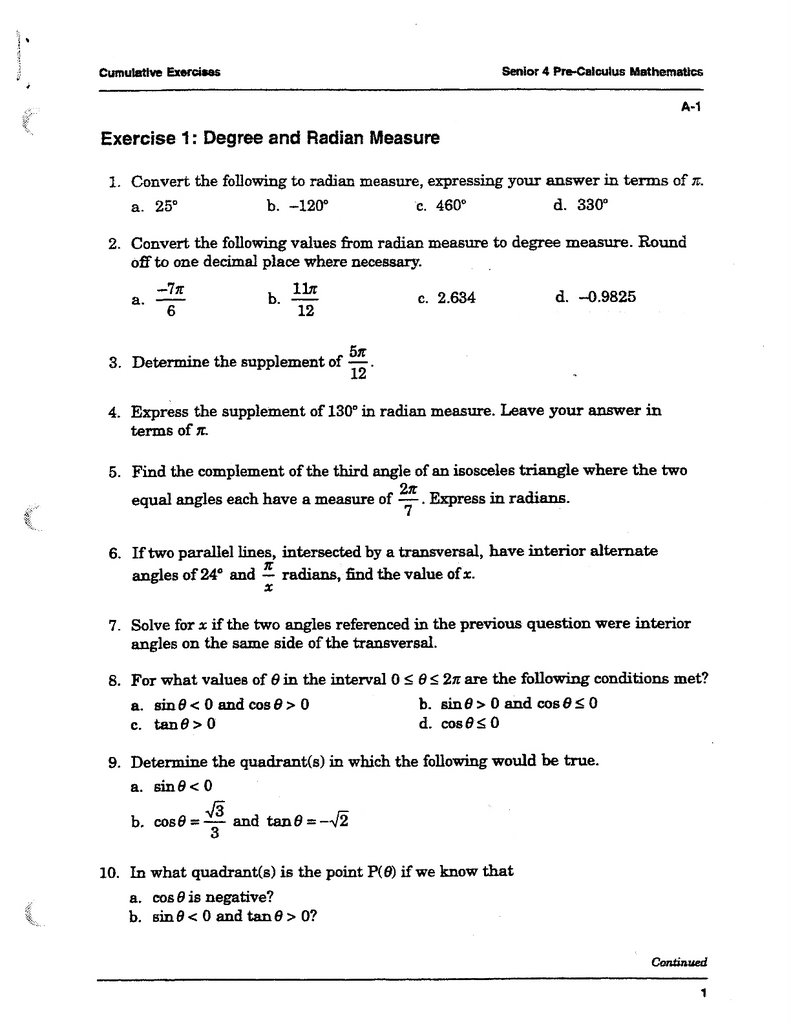
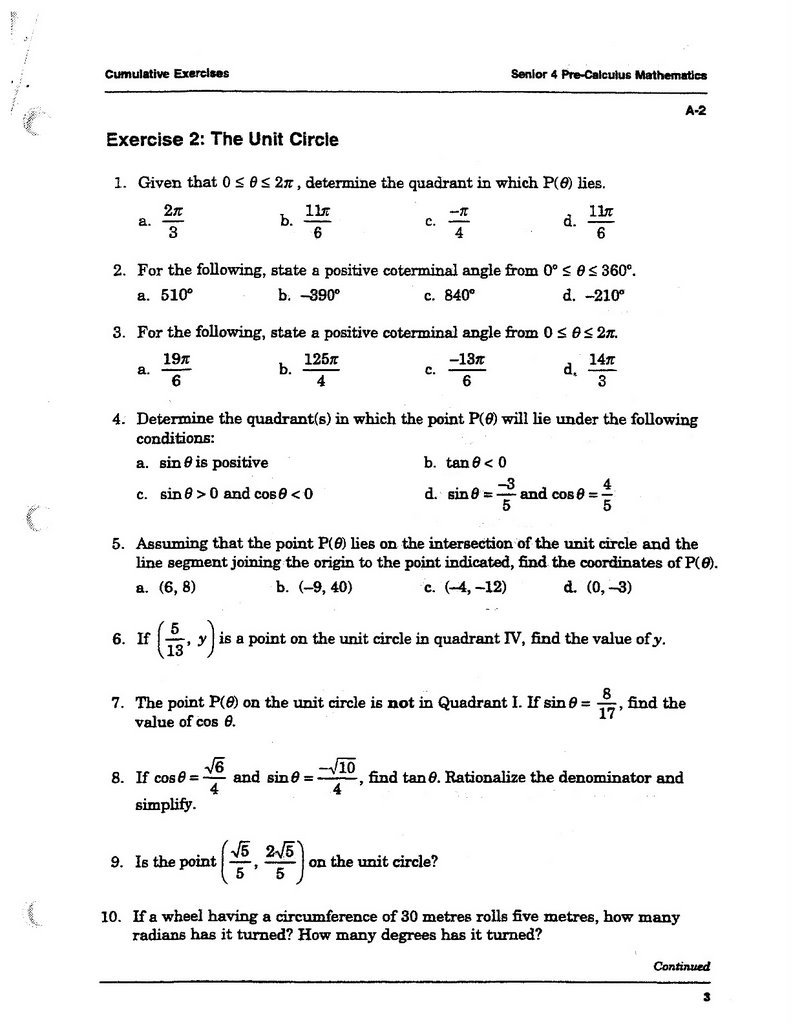
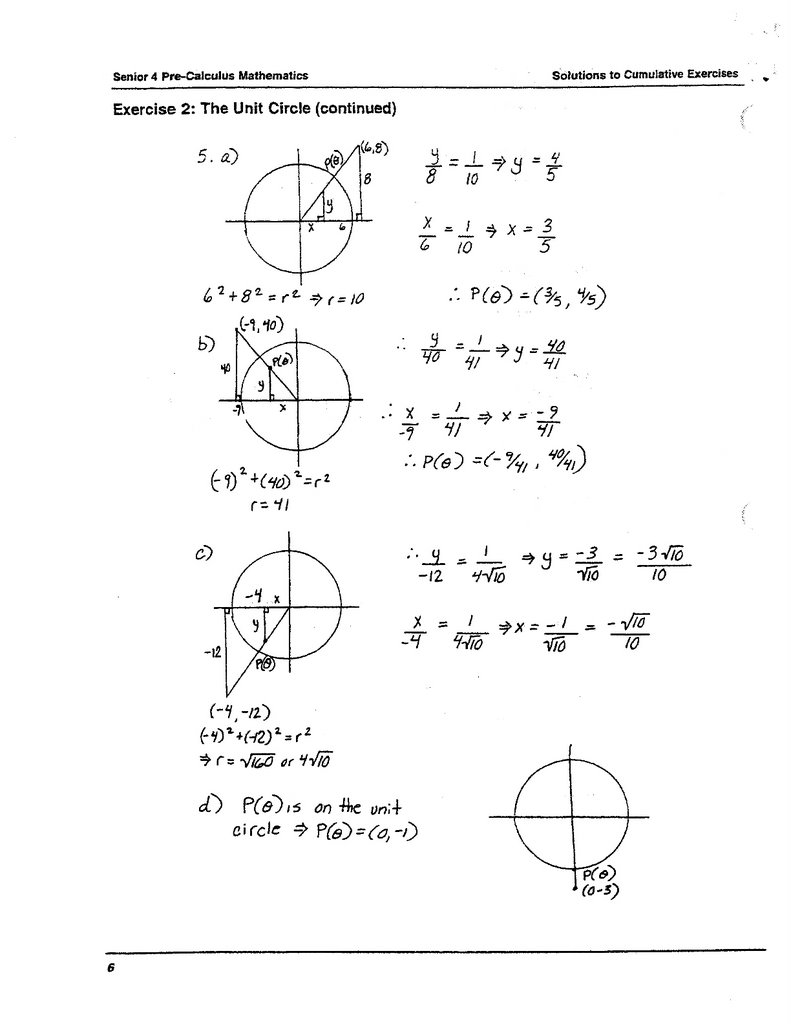
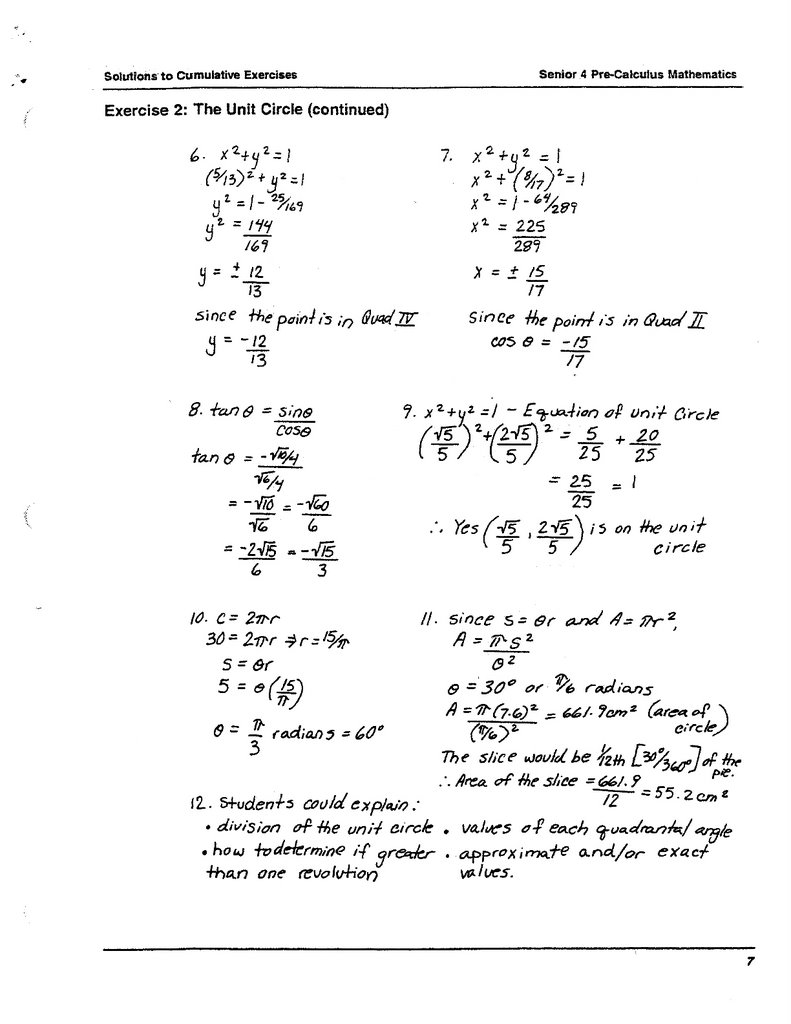
Homework Exercises 1 and 2
As promised, the questions and solutions from the first two homework exercises ...
Exercise 1 Questions: Page 1 of 2, Page 2 of 2
Exercise 1 Solutions: Page 1 of 2, Page 2 of 2
Exercise 2 Questions: Page 1 of 2, Page 2 of 2
Exercise 2 Solutions: Page 1 of 5, Page 2 of 5, Page 3 of 5, Page 4 of 5, Page 5 of 5
Exercise 1 Questions: Page 1 of 2, Page 2 of 2
Exercise 1 Solutions: Page 1 of 2, Page 2 of 2
Exercise 2 Questions: Page 1 of 2, Page 2 of 2
Exercise 2 Solutions: Page 1 of 5, Page 2 of 5, Page 3 of 5, Page 4 of 5, Page 5 of 5
A New Beginning
Hi There! You found our blog! This is the place to talk about what's happening in class; to ask a question you didn't get a chance to ask in class; to get copies of a handout you didn't get in class (here's the course outline); for parents to find out "How Was School Today;" to share your knowledge with other students. Most importantly it's a place to reflect on what we're learning.
Remember what I said about the Forgetting Curve? Well a big part of Learning and Remembering involves working with and discussing new ideas with other people -- THIS is the place to do just that. Use the comment feature below each post, or make your own post, contribute to the conversation and lets get down to some serious blogging!
Here are the slides from today (your homework is on slide #30):
See you tomorrow.
Cheers,
Mr. K.
Remember what I said about the Forgetting Curve? Well a big part of Learning and Remembering involves working with and discussing new ideas with other people -- THIS is the place to do just that. Use the comment feature below each post, or make your own post, contribute to the conversation and lets get down to some serious blogging!
Here are the slides from today (your homework is on slide #30):
See you tomorrow.
Cheers,
Mr. K.
Subscribe to:
Posts (Atom)