I know, confusing name... Dr. L. Og Robert. [hey its like that Beatles song w. Dr. Robert] Logarithm BOB... I can't believe I didn't BOB yet it's pathetic. I was so preoccupied with bio....but I'm here now.
Well... I have to admit that I liked this unit. But there will always be some part of it you don't like. For example, me and graphs, we're not exactly in a good understanding with each other, but we've decided to keep our relationship civil. I'm not exactly comfortable with them yet, but I'm trying. I just have to look back on the other units like transformations to help me solve that.
I seem to have no problem with using the laws, but I also have to confess that I've occasionally forgotten that a LOGARITHM IS AN EXPONENT. Otherwise, I think I'm pretty confident about today, but who knows what'll happen.
Showing posts with label Exponents and Logarithms. Show all posts
Showing posts with label Exponents and Logarithms. Show all posts
Friday, April 25, 2008

Thursday, April 24, 2008
BOB on Logarithms
I almost forgot to BOB, it's a good thing I looked at this blog...before bed. Logarithms are exponents. Yes I remember. Logarithms are also pretty tough. At first I was quite confused about the logarithms are exponents, and the whole anatomy of it, but a little ways into the unit I grasped that concept. I found it quite easy to solve for a value using logarithms, and I thought it was going to be easy street. It's good to remember then, when you see the letter e, use ln, but when it's 10 use log, and if you see neither, then use ln, because its one less letter, good stuff. As I strolled along into the pre-test I unfortunately forgot all about graphing logarithms and I froze thinking about it, but I still don't fully understand it, but I can always study! Compounding interest was pretty interesting, and I never really thought about how interest worked, I just watched my savings grow, but it was nice to learn about how those bankers do it. I found half-life's also pretty interesting and quite straight forward and I loved the story behind it, and how scientists use it to date dinosaur bones. I always wondered why people were so sure about the age of dinosaurs, and now I know, so that was good stuff. It was all good fun, and I learned tons of stuff that weren't directly about pre-cal and it was really interesting. That's pretty much it, good luck everyone!
-Francis
-Francis
BOB version whatever we're at -_-;
Okay well I almost forgot about this. I had to work tonight and was studying and doing crazy amounts of english and blah blah and when I finished I was just ready for bed. Then I remembered the bob for this unit of ours, logarithms and exponents. So because I'm tired, lets get this show on the road.
Pros (or other assorted things I found somewhat easy):
-I found this unit was helped along quite well with the phrase, "A Logarithm is an exponent." Many times when I found myself stuck on a question, I'd turn to this, and usually a eureka moment was soon to follow.
-Much of this unit was algebra, so as long as you had that locked down, almost half the work was done for you.
Cons (or other assorted things I found somewhat difficult):
-For me, one of the hardest parts of this unit was grasping the concepts in it. Usually when I learn something new, I take what I'm taught, and translate it in my head, and change it into a form I can remember. Now for the most part this process goes off without a hitch, but with this unit I found parts of it...trying. For example, I knew the change of base law worked, and I kinda knew where and when to use it, but I had nooo idea HOW it worked, until recently, when I got that cleared up with Mr. K
-Alot of the time I found it downright confusing. Like much of the unit made sense, but seeing the logs and ln's and such all over the place was sometimes disorienting, and a bit smothering. I had to learn to break it down, and take those problems one step at a time, or else I'd get overwhelmed.
Overall:
Not my favourite unit. Not by a long shot. It was interesting yes, and as always Mr. K's teaching methods were inventive and got the point across, and when I needed help he clarified things quite well. However I am almost looking forward to this test tomorrow, because that means they're finished, done, finito; until exam time. I struggled the most with this unit out of all of them by far.
Anyways I'm going to sleep haha. z_z
Justus out,
Ciao.
Pros (or other assorted things I found somewhat easy):
-I found this unit was helped along quite well with the phrase, "A Logarithm is an exponent." Many times when I found myself stuck on a question, I'd turn to this, and usually a eureka moment was soon to follow.
-Much of this unit was algebra, so as long as you had that locked down, almost half the work was done for you.
Cons (or other assorted things I found somewhat difficult):
-For me, one of the hardest parts of this unit was grasping the concepts in it. Usually when I learn something new, I take what I'm taught, and translate it in my head, and change it into a form I can remember. Now for the most part this process goes off without a hitch, but with this unit I found parts of it...trying. For example, I knew the change of base law worked, and I kinda knew where and when to use it, but I had nooo idea HOW it worked, until recently, when I got that cleared up with Mr. K
-Alot of the time I found it downright confusing. Like much of the unit made sense, but seeing the logs and ln's and such all over the place was sometimes disorienting, and a bit smothering. I had to learn to break it down, and take those problems one step at a time, or else I'd get overwhelmed.
Overall:
Not my favourite unit. Not by a long shot. It was interesting yes, and as always Mr. K's teaching methods were inventive and got the point across, and when I needed help he clarified things quite well. However I am almost looking forward to this test tomorrow, because that means they're finished, done, finito; until exam time. I struggled the most with this unit out of all of them by far.
Anyways I'm going to sleep haha. z_z
Justus out,
Ciao.
Logarithms and Exponents Practice
I can see that most of you guys are loving this unit, but I still made a collection of online quizzes that can be found around the net.There are many good sites out there that you can practice on, so I decided to make a list of few sites that will definitely help all of you. Here it goes:
Link 1
Link 2
Link 3
Link 4
Link 5
Link 6
Link 7
Link 8
Link 9
Link 10
I planned to post this earlier but my internet connection is acting weird because of the weather outside.
-m@rk
Link 1
Link 2
Link 3
Link 4
Link 5
Link 6
Link 7
Link 8
Link 9
Link 10
I planned to post this earlier but my internet connection is acting weird because of the weather outside.
-m@rk
BOB on LOGS
So, this was a fair unit. I had my ups and downs... Like a sine function but yeah, overall this was pretty easy after you grasp the concept that a Logarithm is an exponent.. Even though you're gonna forget that. The whole Base, Arguement/Power equals an exponent was pretty easy. Even when he threw in the X's and what not, It was still basic quadratic equations. (Oh and don't forget, -b +/- squareroot bsquared - 4ac all over 2a :D (Trust me, it's helpful). Then we found what is called.. A natural logarithm. Ln (pronounced Ellen..). Apparently it's easier BECAUSE it has ONE LESS LETTER. Oh yey.
Then the graphing. It was... okay. Wasnt' the greatest experience in the world, but I'm still studying up on it. The whole fact that it gets infinitely close to 0 is well. Unreal. Concave up (remember it's like a sharp, curved, turn... to say the least.) or down. I liked the simplicity of the unit.. until it all came crashing down with this crazy stuff. We also learned about compound interest :D. Now we can all beat the bankers! xD A = Ao(model) t, which was also another thing we learned, and it was all geezy, until we started getting the wrong answers =/ But this was a real good unit. I'll definitely study hard for this one. >:D
Then the graphing. It was... okay. Wasnt' the greatest experience in the world, but I'm still studying up on it. The whole fact that it gets infinitely close to 0 is well. Unreal. Concave up (remember it's like a sharp, curved, turn... to say the least.) or down. I liked the simplicity of the unit.. until it all came crashing down with this crazy stuff. We also learned about compound interest :D. Now we can all beat the bankers! xD A = Ao(model) t, which was also another thing we learned, and it was all geezy, until we started getting the wrong answers =/ But this was a real good unit. I'll definitely study hard for this one. >:D
Rence ~ Out
Logarithms and Exponent Bob
I almost forgot to bob! How could I forget such a thing? Hmmm shall I start with the good news or bad news first? Didn't Mr. K say it was always better to start off with the good news?
Anyways, I find this unit pretty straight forward. It was just in the beginning where it was sort of confusing because of all the "logarithms are exponents" saying. After finally understanding and getting the concept of treating logs as exponents, things became waay easier. I really hope there's a lot of those power, quotient, and product law questions on the test because I really like solving them. However, on that quiz we got where we had to solve for K I messed it up really bad. I forgot to divide everything so I could get the base e by itself an just ended up going straight to the step where you put log on both sides. Well I guess that quiz helped me see what I was doing wrong. I find myself not making that mistake anymore because of that quiz now. Oh yeah, am I the only one who likes using log better than ln?!
The worst part of this unit for me would probably the graphing. All the inverse talk confuses me but I'm starting to get it now....slowly. What I was doing wrong was I didn't start off trying to graph the original but went straight to the ln or log so I was just making it harder for myself.
I hope I do well on the test tomorrow :D. Sooo I better start reviewing the slides.
Anyways, I find this unit pretty straight forward. It was just in the beginning where it was sort of confusing because of all the "logarithms are exponents" saying. After finally understanding and getting the concept of treating logs as exponents, things became waay easier. I really hope there's a lot of those power, quotient, and product law questions on the test because I really like solving them. However, on that quiz we got where we had to solve for K I messed it up really bad. I forgot to divide everything so I could get the base e by itself an just ended up going straight to the step where you put log on both sides. Well I guess that quiz helped me see what I was doing wrong. I find myself not making that mistake anymore because of that quiz now. Oh yeah, am I the only one who likes using log better than ln?!
The worst part of this unit for me would probably the graphing. All the inverse talk confuses me but I'm starting to get it now....slowly. What I was doing wrong was I didn't start off trying to graph the original but went straight to the ln or log so I was just making it harder for myself.
I hope I do well on the test tomorrow :D. Sooo I better start reviewing the slides.
BOB Version 4: Exponents and Logarithms
Dear BOB,
I'm not comfortable with the graphing section of this unit.
Yes BOB, that's my first sentence of this post. Yes, I'm breaking the traditional rules of paragraph-writing by moving a detail up to the front line, where my introduction should be, so that my point stands out definite, clear, and observable. This just means I have to put time in to graphing exponential and logarithmic functions because, as the saying goes, practice makes perfect.
Well if reading that first statement gave you an unhappy impression, well guess what? As of now, I haven't done Exercise 27 or looked at the stuff that our class did while I was away at my mini-u and conferences, honestly speaking, which means I have to put a bit more emphasis in that section of this unit when studying.
But if you're feeling so depressed, don't worry about it! On the brighter side, I can handle the basics of this unit and the stuff we previously learned near the beginning of this unit, i.e., solving exponential and logarithmic equations and using logarithmic theorems. PLUS, I STILL REMEMBER THAT A LOGARITHM IS AN EXPONENT! (Even though I'm admitting to Special K that he was right--that I did forget that important fact from time to time.)
I hope we can come to an understanding in precal. Let's hope that in the end we all end up as happy smiling people infecting the world with our angelic smiles.
That is all for now. Good day.
Sincerely yours,
zeph
I'm not comfortable with the graphing section of this unit.
Yes BOB, that's my first sentence of this post. Yes, I'm breaking the traditional rules of paragraph-writing by moving a detail up to the front line, where my introduction should be, so that my point stands out definite, clear, and observable. This just means I have to put time in to graphing exponential and logarithmic functions because, as the saying goes, practice makes perfect.
Well if reading that first statement gave you an unhappy impression, well guess what? As of now, I haven't done Exercise 27 or looked at the stuff that our class did while I was away at my mini-u and conferences, honestly speaking, which means I have to put a bit more emphasis in that section of this unit when studying.
But if you're feeling so depressed, don't worry about it! On the brighter side, I can handle the basics of this unit and the stuff we previously learned near the beginning of this unit, i.e., solving exponential and logarithmic equations and using logarithmic theorems. PLUS, I STILL REMEMBER THAT A LOGARITHM IS AN EXPONENT! (Even though I'm admitting to Special K that he was right--that I did forget that important fact from time to time.)
I hope we can come to an understanding in precal. Let's hope that in the end we all end up as happy smiling people infecting the world with our angelic smiles.
That is all for now. Good day.
Sincerely yours,
zeph
BOB: Logs and Exponents
After reading my own blog, I realized I myself didn't even BOB yet.. ): So here I am with another one!
The very beginning of this unit wasn't so bad, we started with pretty simple questions which I was comfortable solving. Though Mr. K says we'll forget about the whole a "logarithm is an exponent," I hope I won't forget but there are moments where I do :( In the beginning of the unit the questions were straight forward and I have to admitt, I liked solving many of them. I felt comfortable using the product, quotient, and power law as well as solving the logarithmic equations. I also found that using "ln" is easier, just because it's one letter less than log. Just kidding! Actually, I don't mind using "ln" I find it the same but I do struggle with a few questions.
I guess the most trouble I have in this unit is exponential modeling. It's sort of confusing only because I have a harder time understanding what the question is asking. I never really liked word problems and even back in the day, I wasn't very good at it. I guess it just takes a bit more time for me. I also have trouble with graphing different exponential functions. I had trouble with graphing before and I don't think I'll be good at that certain area.
Other than that, I thought this unit wasn't so bad, a lot of algebra, but it still wasn't as bad as I thought it would be. Hopefully I do really well for tomorrow's test and even though I say that, after writing the test, I always feel like I bombed it. ): Anyways, that's all folks and goodluck to everyone!
The very beginning of this unit wasn't so bad, we started with pretty simple questions which I was comfortable solving. Though Mr. K says we'll forget about the whole a "logarithm is an exponent," I hope I won't forget but there are moments where I do :( In the beginning of the unit the questions were straight forward and I have to admitt, I liked solving many of them. I felt comfortable using the product, quotient, and power law as well as solving the logarithmic equations. I also found that using "ln" is easier, just because it's one letter less than log. Just kidding! Actually, I don't mind using "ln" I find it the same but I do struggle with a few questions.
I guess the most trouble I have in this unit is exponential modeling. It's sort of confusing only because I have a harder time understanding what the question is asking. I never really liked word problems and even back in the day, I wasn't very good at it. I guess it just takes a bit more time for me. I also have trouble with graphing different exponential functions. I had trouble with graphing before and I don't think I'll be good at that certain area.
Other than that, I thought this unit wasn't so bad, a lot of algebra, but it still wasn't as bad as I thought it would be. Hopefully I do really well for tomorrow's test and even though I say that, after writing the test, I always feel like I bombed it. ): Anyways, that's all folks and goodluck to everyone!
AP Cal. & Pre Test: Logs and Exponents
Hey everyone it's Rox and once again I'm scribe for today's class. (:
Today's class we started off with Mr. K asking us if we are all going to be in AP calculus for next year or if were at least interested in it. Sadly, only 6 people are highly interested in it and are for sure wanting to be the class. However, for the class to actually "fly" at least 13 students must sign up or there will be no AP Cal. next year. Though your mark may go down by about 20% remember that it is a university course not a high school course. So we spent about 20-25 minutes talking about advantages of taking it next year.
1. In university, it takes 13 weeks (3 hours a day) to learn the whole entire ball of wax but if you choose to take it next year, it takes 8 months (5 hours a day) to go through the whole course.
2. If you do really well, you'll recieve money, up to 200-250 dollars I believe.
3. After you write the exam for the AP course, there's another exam a week after which is a "take home exam." Mr. K says it takes about 2-3 weeks which varies if you talk to him about it.
4. Previous students who took the AP Cal. course recieved 90's in university. (:
After we dicussed about how our marks in high school won't matter 10 years from now when we're applying for our career jobs. Marks in high school only count to get into university after that I suppose it's all history. They're only looking for our high school certificate and our university transcipt. Though it is difficult and it takes hard work, it will only pay off at the end. Mr K also mentioned to take as many AP courses as you can so in the future if you wish to switch, it won't be difficult to get into another course if you already have your AP bio, chem, art, etc.
Continuing today's class, we then wrote our Pre Test for Logs and Exponents. As usual we had several minutes writing the pre test then got into groups and worked as a team to solve each question. We had about 10-12 minutes before we handed in our pre test so we didn't get to go through all the answers. BUT I'm sure everyone still did well, even though we were sort of arguing on number 2 whether it was a or b. Luckily it was a after all! Yay to my group! Anyways, answers are posted up so if there are any uncertainties, take a look at the slides.
I believe I covered everything we did today and good luck to everyone for tomorrow's test. DON'T FORGET TO BOB... AND REMEMBER A LOGARITHM IS AN EXPONENT! Let's not forget, knock on wood! So I guess it's time for me to head out and choose the next scribe which will be.. uhm Justus!!
Today's class we started off with Mr. K asking us if we are all going to be in AP calculus for next year or if were at least interested in it. Sadly, only 6 people are highly interested in it and are for sure wanting to be the class. However, for the class to actually "fly" at least 13 students must sign up or there will be no AP Cal. next year. Though your mark may go down by about 20% remember that it is a university course not a high school course. So we spent about 20-25 minutes talking about advantages of taking it next year.
1. In university, it takes 13 weeks (3 hours a day) to learn the whole entire ball of wax but if you choose to take it next year, it takes 8 months (5 hours a day) to go through the whole course.
2. If you do really well, you'll recieve money, up to 200-250 dollars I believe.
3. After you write the exam for the AP course, there's another exam a week after which is a "take home exam." Mr. K says it takes about 2-3 weeks which varies if you talk to him about it.
4. Previous students who took the AP Cal. course recieved 90's in university. (:
After we dicussed about how our marks in high school won't matter 10 years from now when we're applying for our career jobs. Marks in high school only count to get into university after that I suppose it's all history. They're only looking for our high school certificate and our university transcipt. Though it is difficult and it takes hard work, it will only pay off at the end. Mr K also mentioned to take as many AP courses as you can so in the future if you wish to switch, it won't be difficult to get into another course if you already have your AP bio, chem, art, etc.
Continuing today's class, we then wrote our Pre Test for Logs and Exponents. As usual we had several minutes writing the pre test then got into groups and worked as a team to solve each question. We had about 10-12 minutes before we handed in our pre test so we didn't get to go through all the answers. BUT I'm sure everyone still did well, even though we were sort of arguing on number 2 whether it was a or b. Luckily it was a after all! Yay to my group! Anyways, answers are posted up so if there are any uncertainties, take a look at the slides.
I believe I covered everything we did today and good luck to everyone for tomorrow's test. DON'T FORGET TO BOB... AND REMEMBER A LOGARITHM IS AN EXPONENT! Let's not forget, knock on wood! So I guess it's time for me to head out and choose the next scribe which will be.. uhm Justus!!

Wednesday, April 23, 2008
BOB: Logarithms and Exponents
Its that time of the month again, yes, that's right, test time, and therefore its time to BOB! Well, with this unit, I found the basic stuff to be pretty simple. Just learning about the various laws and how to solve simple problems with logarithms and exponents was the easiest part. Learning about the natural logarithm was also not that hard, along with the compound interest and model stuffs.
Now, for the hard parts, I still find graphing things a bit challenging. I also found it hard to do those questions which say to solve for "this variable", be that k or x. An example of this would be those two questions from that quiz we had a few days ago when we had a sub. I have a feeling I really messed up those questions, and I mean really.
K that's all, ciao bella? o_O
Now, for the hard parts, I still find graphing things a bit challenging. I also found it hard to do those questions which say to solve for "this variable", be that k or x. An example of this would be those two questions from that quiz we had a few days ago when we had a sub. I have a feeling I really messed up those questions, and I mean really.
K that's all, ciao bella? o_O
Back Again...
... But this time, I'm here to BOB!
So, Logarithms and Exponents, I thought this unit was pretty cool. Although I have mentioned more than once, to more than one person, that by the time I finish this unit (or course, depending on whether or not we'll use logarithms in other units), I would probably be sick of the word 'log' and the letters 'ln', seriously.
As always, my weakest area in this unit, is the graphing. Bleh, me and graphs just don't get along. Buut I'm working on it, so you know, it should be good? Maybe? The word problems are also a little hard, but then again, I'm not really a 'word problems' kinda person either. I have a hard time coming up with an equation for the question, and of course I can't solve any other question until I have that.. so I most likely need practice. I'm probably gonna ask Jamie if we could DEV this? Jamie? Hahaha, I need practice.
I liked solving the problems though, using log and ln, yeah, that's fun. But sometimes I have to stare at it a little to help me figure out how to solve it, which isn't good, seeing as there's a time limit and all. But hopefully I'll get past that and just get straight to it.
So yes, that is it. The end. Time for me to find some del.icio.us links because I sadly, have not yet. Good luck on the test everyone! Do your best. =) Study hard!
So, Logarithms and Exponents, I thought this unit was pretty cool. Although I have mentioned more than once, to more than one person, that by the time I finish this unit (or course, depending on whether or not we'll use logarithms in other units), I would probably be sick of the word 'log' and the letters 'ln', seriously.
As always, my weakest area in this unit, is the graphing. Bleh, me and graphs just don't get along. Buut I'm working on it, so you know, it should be good? Maybe? The word problems are also a little hard, but then again, I'm not really a 'word problems' kinda person either. I have a hard time coming up with an equation for the question, and of course I can't solve any other question until I have that.. so I most likely need practice. I'm probably gonna ask Jamie if we could DEV this? Jamie? Hahaha, I need practice.
I liked solving the problems though, using log and ln, yeah, that's fun. But sometimes I have to stare at it a little to help me figure out how to solve it, which isn't good, seeing as there's a time limit and all. But hopefully I'll get past that and just get straight to it.
So yes, that is it. The end. Time for me to find some del.icio.us links because I sadly, have not yet. Good luck on the test everyone! Do your best. =) Study hard!
The Trouble with Tribbles
Hi fellow classmates this is not Justus this is Richard. Justus was away from class today so i was chosen to be todays scribe. For those who were not in class you guys are probably wondering why is the first slide about Star Trek. Well that is going to have to wait.
Class started off with looking at a question that we did yesterday. After that we saw a clip of a Star Trek episode called The Trouble With Tribbles. If you want to watch it there is a video link on slide 3. After we watched it we wrote down The calculations that Spock had said. We then decided to check if the calculations that Spock said were correct.

After making an equation we then concluded that Spock had lied.
We then decided to ponder was Spock really wrong?? or did he just round it to 3 days.
On Slide 5, 6, and 7 are all calculations to check if Spock was right. There are also many different ways on how to solve logarithms. on slide 6 Paul used time in days not hours with log. Joyce used time in hours not days with logs. And Roxanne used time in hours not days with Ln. As you can see All the answers are the same. with exceptions to rounding.
Here is a reminder to everybody make sure to round to four decimal places if answer is not specified to any digit. Also make sure not to use slashes in your division because it might lead to errors.

On slide 8 is just a modification on how to make your work look more eloquent. And also to tell everyone that Spock never lied. He is smart and has no emotions.
On Slide 9 the value of t was wrong. On the same slide we debated on what the was could be.?? would it be base 100e ^-0.0017t or was it one hundred times base e^ -0.0017t. After a really really long debate we concluded that it was just one hundred times base e^ -0.0017t.
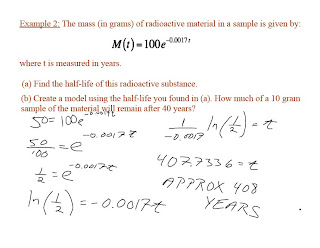
Now on Slide 10 we then found the correct answer. If you are wondering on how to do this question here is how. The first thing you do is right down the equation. The next step would be to divide both sides buy one hundred. The Next step would be to take the ln of both side because its already at base e. The fourth step would be to divide both sides by -0.0017 . And finally the last step would be to solve for t by putting the equation correctly in your calculator.

On slide 11 we then got rearrange in to groups and started to solve for question b of example 2.
To solve this question you needed to use a new formula that we created. Which is the bottom formula of slide 11. Or the slide above us.

Now the 12 and final slide of the day. On this slide we were given a question that had to do with Canada's population.
We were given information and for question (a) we had to write an equation that represents the population of Winnipeg. One problem that people had including myself was that 0.54 % is not 0.54 it is actually 0.0054. Another problem is that you need to add one to the rate or else it wont take into affect the other previous times. and also if you don't add one it will be a negative value.
Now for (b) you needed to make P(y) to double of 630700 which is 1261400 and then solve for y in the exponent. The first step to do is to divide both sides by 630700 so that your left with 2 = 1.0054^y after that you could take the log or the ln of both sides. (The one that i would pick would be ln because it is one less letter then log.) the next step is to rearrange the question to solve for y. After that is done you could then just plug in the values into your calculator and your done.
Well now that the scribe is done time to pick a new scribe. The scribe is going to be Roxanne.
Class started off with looking at a question that we did yesterday. After that we saw a clip of a Star Trek episode called The Trouble With Tribbles. If you want to watch it there is a video link on slide 3. After we watched it we wrote down The calculations that Spock had said. We then decided to check if the calculations that Spock said were correct.

After making an equation we then concluded that Spock had lied.
We then decided to ponder was Spock really wrong?? or did he just round it to 3 days.
On Slide 5, 6, and 7 are all calculations to check if Spock was right. There are also many different ways on how to solve logarithms. on slide 6 Paul used time in days not hours with log. Joyce used time in hours not days with logs. And Roxanne used time in hours not days with Ln. As you can see All the answers are the same. with exceptions to rounding.
Here is a reminder to everybody make sure to round to four decimal places if answer is not specified to any digit. Also make sure not to use slashes in your division because it might lead to errors.

On slide 8 is just a modification on how to make your work look more eloquent. And also to tell everyone that Spock never lied. He is smart and has no emotions.
On Slide 9 the value of t was wrong. On the same slide we debated on what the was could be.?? would it be base 100e ^-0.0017t or was it one hundred times base e^ -0.0017t. After a really really long debate we concluded that it was just one hundred times base e^ -0.0017t.

Now on Slide 10 we then found the correct answer. If you are wondering on how to do this question here is how. The first thing you do is right down the equation. The next step would be to divide both sides buy one hundred. The Next step would be to take the ln of both side because its already at base e. The fourth step would be to divide both sides by -0.0017 . And finally the last step would be to solve for t by putting the equation correctly in your calculator.

On slide 11 we then got rearrange in to groups and started to solve for question b of example 2.
To solve this question you needed to use a new formula that we created. Which is the bottom formula of slide 11. Or the slide above us.

Now the 12 and final slide of the day. On this slide we were given a question that had to do with Canada's population.
We were given information and for question (a) we had to write an equation that represents the population of Winnipeg. One problem that people had including myself was that 0.54 % is not 0.54 it is actually 0.0054. Another problem is that you need to add one to the rate or else it wont take into affect the other previous times. and also if you don't add one it will be a negative value.
Now for (b) you needed to make P(y) to double of 630700 which is 1261400 and then solve for y in the exponent. The first step to do is to divide both sides by 630700 so that your left with 2 = 1.0054^y after that you could take the log or the ln of both sides. (The one that i would pick would be ln because it is one less letter then log.) the next step is to rearrange the question to solve for y. After that is done you could then just plug in the values into your calculator and your done.
Well now that the scribe is done time to pick a new scribe. The scribe is going to be Roxanne.
Today's Slides: April 23
Tuesday, April 22, 2008
EXPONENTIAL MODELING
It's late and I've had to start this post three times because my internet connection is as stable as a one-legged table. It's beginning to tick me off.
Today, we've started a new sub-unit having to do with logarithms and exponents. Of course, as the title states, we studied EXPONENTIAL MODELING. This of course is how we model real life situations depending on what kind or how much information is given.
To be honest, I'm not the one who follows the whole OUTLINE idea, because not everything I write is written in stone. All I can do is tell you what exactly I recall. The first thing that comes into mind is the initiating slide of our lesson looking like:
[place picture here, something is glitchy with the picture uploader]
The slide had an image of the world drawn in the means of the population of various areas. While we were on the topic of using such an example, we went to a site:
Today, we've started a new sub-unit having to do with logarithms and exponents. Of course, as the title states, we studied EXPONENTIAL MODELING. This of course is how we model real life situations depending on what kind or how much information is given.
To be honest, I'm not the one who follows the whole OUTLINE idea, because not everything I write is written in stone. All I can do is tell you what exactly I recall. The first thing that comes into mind is the initiating slide of our lesson looking like:
[place picture here, something is glitchy with the picture uploader]
The slide had an image of the world drawn in the means of the population of various areas. While we were on the topic of using such an example, we went to a site:
This was a population clock in which the rate was determined by multiplying by a factor of approx. 1%, which was determined by a model found in a certain equation, which will come up once more later. As well as that, we were brought to:
T$$he class was put into separate workshop groups and were asked to solve the questions on slide 2. In the first example, Thi wrote his solution on the smart board, which was correct, but technically incomplete or not simplified to the fullest extent. The class learns that towards the end of the solution, "lne" is also finding the log base e of e which is 1. Therefore the final answer could've been simplified as: ln2/1 - ln2 instead of ln2/lne - ln2. In the red, it was also shown that this I guess, "mistake" could've been found in the first step, where we would transpose the x because of the power law and then find the ln of "x ln e" which is just x and it's simple grade ten algebra from there.
The second example could've also been done a little differently than it was shown on the slides; remembering that a logarithm is an exponent, etc...I didn't forget. Ergo, the question could also be written as e^5 = ln (2t - 1) making the process of finding the missing variable a little easier. Since the power is written like this in it's new form, we could find the ln of both sides which will leave us with 5 = 2t - 1 of course considering that ln e = 1 and the ln of ln terminates both ln leaving the variable to be isolated. The result after basic algebra is t = 3.
Once again, after solving some refreshers, we were introduced to exponential modeling which relates to real life situations. As we know, in normal exponential functions the basic function is:
f (x) = a * b^x
(0, 1) is always an invariant point in exponential functions. This is so because x = 0. x is the exponent of b and anything to the power of 0 is 1. a is also the y-intercept.
So far the class was shown two types of classification within the idea of exponential modeling.
CASE 1: (working with a minimal amount of information, using variables A Ao and change in time.) The model was either going to be in either base 10 or e. But e is more preferred.
ex. Population of the earth was 5.3 billion in 1990. In 2000, it was 6.1 billion .
A = Ao (model)^t
Where:
A is the product
Ao is the initial amount [pronounced "a not"]
model is with base 10 or e.
We used this equation and plugged in the given values and isolate out the unknown value, which in this case happens to be the "model" variable. ge class tried solving this problem trying both bases and we end up with the same value but if it were to be done in base 10, an extra step would have to be taken. Getting the answer by the means of base e is shorter because the exponent of e is the rate of percentage the initial amount increases by.
Finally there was the second type of model, where the equation is NOT similar to the continuous compound interest rate like the last one was. In this model:
A = Ao (m)^(t/p)
Where:
A = amount of substance
Ao = initial amount
m = multiplying factor
t = time
p = period
The only thing we had time for was to plug in the values and isolate the unknowns so they can be solved. In this case, the unknown was the amount of the "substance". The lesson will surely continue the next class. Now I leave the responsibilty of finishing to Justus. Reminder: BOB, del.icio.us tag and do exercise "the next" which is I think 24 or 25 I'm too lazy to check my notes.
Finally, Mr. K, you haven't shown us Thousand Island and you also haven't given us back our questions yet. We all want to get our DEV's finished, please and thanks.
Monday, April 21, 2008
SUBBER-DUCKY
A subber-ducky is a really cool inter-species of rubber ducky. I'm kidding... but do you see how my mind works? It's kind of messed up with rusty gears in there. I don't exactly think of useful things. We had a substitute today and all I have to say is that everyone in the class proved how mature they really are, even if we were left practically unsupervised. Mrs. Gonzaga was a sweetheart and we all worked productively.
Now this isn't exactly the type of post where I could I guess, continue the use of Joseph's very well organized scribing method since we only did two things today. Firstly, we started off with a short quiz-- which I probably bombed. I know I'm not supposed to think that way, but trust me I know what happens. But for those of us in the class that were wondering what the formula was, it was:
A = P (1 + r/n)^nt
Where,
P = principal amount (initial investment)
r = annual interest rate (as a decimal)
n = number of times the interest is compounded per year
t = number of years
A = amount after time t
I'm assuming you're wondering why I don't change colours in my scribe. This picture will show you why.
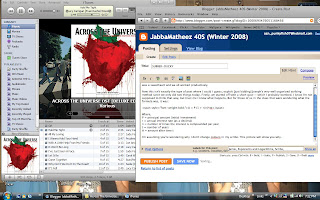
Sorry, I was lazy to crop the important bit, so consequently you know what I'm listening to. But the thing is I CAN'T CHANGE FONT COLOURS!!! It's supposed to be beside the BOLD OPTION. Help?
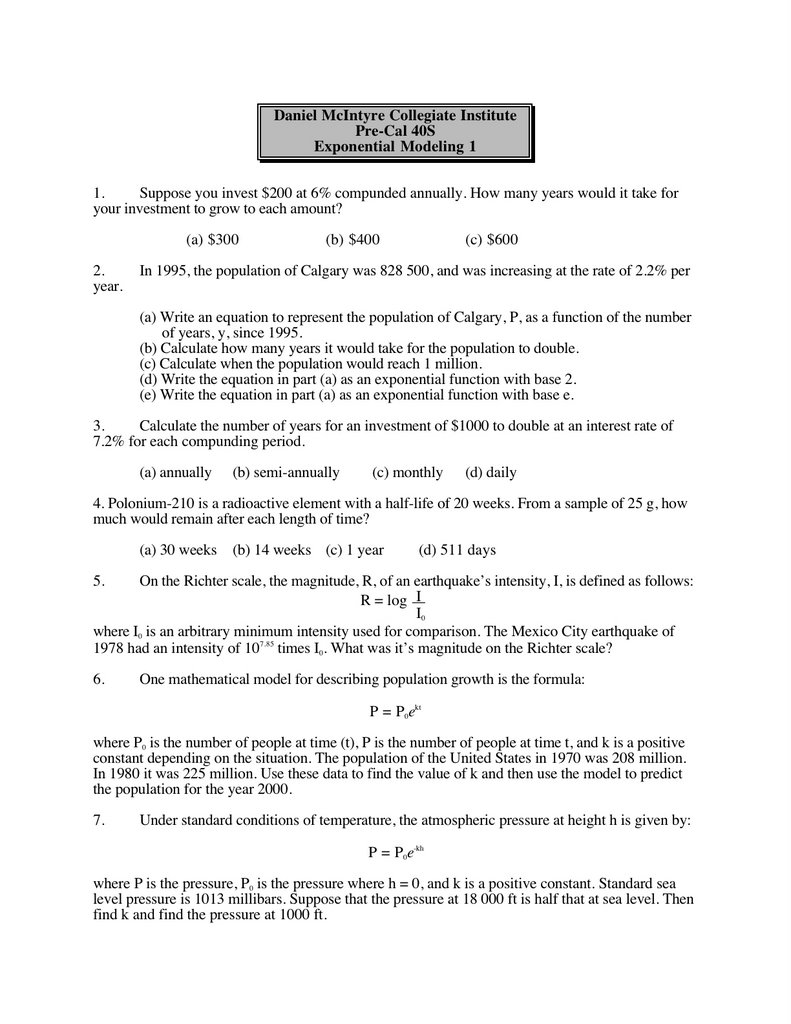
Anyways, immediately after that, we were given a worksheet to practice our skills in solving problems with logarithms [which are exponents.] I wish I could change colour-- I guess I'll have to settle with colourful vocabulary. By the way, the spellcheck is telling me to change COLOURS into COLORS. Clearly someone's not Canadian. Here is the sheet for those who missed today's class because of mini-U or HSM. While we're on this topic, there was a huge debacle I happened to come across while listening to my Beatles songs on my iPod. High School Musical. I guess every school is treating that like a LEGITIMATE play. I mean, it is, in a way, because it is strongly endorsed by a "little-company-that-could" named Disney. But I'm sure everyone's heard the satirical jokes about the sequels on SNL. Face it, by the third and fourth installment, the protagonists have surely YET to graduate. Once they do, there is no "high school" musical [and there never really was at the end of the first one, which I anticipated]. It's like the show LOST or PRISON BREAK, there is no show if they're found and out of jail. I don't mean to disrespect, but math class is important...and also...I don't believe in the choice of musical even though it was brought up by popular demand. But then again, I am not "popular demand". I'm sorry for the tangent. What I can't do in font colours I make up in length. Trust me, there are no drafts.. I just type and it's bad when I type in my Stephen Colbert critical mode like I am now. But in all world peace and order, here's the sheet:
QUESTIONS:

ANSWERS:

That was basically all we did today even though I always seem to elongate every little detail. I apologize and also I apologize once again because I'm picking myself as scribe again tomorrow, but I want to get it over with, but I can't promise that I won't ramble. Actually, I'm picking my alter-ego "Ja-you". I have issues with names. "PBnJamieSnagwich" is the mystery nickname according to you guys: It's basically PB & J Sandwich..but I don't say "sandwich". It's too...maginary. I know it tastes awesome Mr. K but I'm a literal eater. You never truly appreciate something unless it's gone. We miss your yogurt and your mad geography skills. But here's a challenge. Why don't you tell the class where exactly THOUSAND ISLAND IS? hahah
well I'm out. Remember, test on logarithms towards the end of the week! Remember to call up BOB or Robert...he's a good person to have around when nearing a test. Also, eat very suc.cule,nt and del.icio.us-ly healthy foods. I'm FINALLY out.
Now this isn't exactly the type of post where I could I guess, continue the use of Joseph's very well organized scribing method since we only did two things today. Firstly, we started off with a short quiz-- which I probably bombed. I know I'm not supposed to think that way, but trust me I know what happens. But for those of us in the class that were wondering what the formula was, it was:
A = P (1 + r/n)^nt
Where,
P = principal amount (initial investment)
r = annual interest rate (as a decimal)
n = number of times the interest is compounded per year
t = number of years
A = amount after time t
I'm assuming you're wondering why I don't change colours in my scribe. This picture will show you why.
Sorry, I was lazy to crop the important bit, so consequently you know what I'm listening to. But the thing is I CAN'T CHANGE FONT COLOURS!!! It's supposed to be beside the BOLD OPTION. Help?
Anyways, immediately after that, we were given a worksheet to practice our skills in solving problems with logarithms [which are exponents.] I wish I could change colour-- I guess I'll have to settle with colourful vocabulary. By the way, the spellcheck is telling me to change COLOURS into COLORS. Clearly someone's not Canadian. Here is the sheet for those who missed today's class because of mini-U or HSM. While we're on this topic, there was a huge debacle I happened to come across while listening to my Beatles songs on my iPod. High School Musical. I guess every school is treating that like a LEGITIMATE play. I mean, it is, in a way, because it is strongly endorsed by a "little-company-that-could" named Disney. But I'm sure everyone's heard the satirical jokes about the sequels on SNL. Face it, by the third and fourth installment, the protagonists have surely YET to graduate. Once they do, there is no "high school" musical [and there never really was at the end of the first one, which I anticipated]. It's like the show LOST or PRISON BREAK, there is no show if they're found and out of jail. I don't mean to disrespect, but math class is important...and also...I don't believe in the choice of musical even though it was brought up by popular demand. But then again, I am not "popular demand". I'm sorry for the tangent. What I can't do in font colours I make up in length. Trust me, there are no drafts.. I just type and it's bad when I type in my Stephen Colbert critical mode like I am now. But in all world peace and order, here's the sheet:
QUESTIONS:

ANSWERS:

That was basically all we did today even though I always seem to elongate every little detail. I apologize and also I apologize once again because I'm picking myself as scribe again tomorrow, but I want to get it over with, but I can't promise that I won't ramble. Actually, I'm picking my alter-ego "Ja-you". I have issues with names. "PBnJamieSnagwich" is the mystery nickname according to you guys: It's basically PB & J Sandwich..but I don't say "sandwich". It's too...maginary. I know it tastes awesome Mr. K but I'm a literal eater. You never truly appreciate something unless it's gone. We miss your yogurt and your mad geography skills. But here's a challenge. Why don't you tell the class where exactly THOUSAND ISLAND IS? hahah
well I'm out. Remember, test on logarithms towards the end of the week! Remember to call up BOB or Robert...he's a good person to have around when nearing a test. Also, eat very suc.cule,nt and del.icio.us-ly healthy foods. I'm FINALLY out.
Sunday, April 20, 2008
BOB for Log and Expos
This unit is by far the most difficult unit for me. I will be missing the test and a week of class so I hope that won't affect me significantly. So for this unit I take too much time in solving the questions. I usually have to look at examples before i start on question. That was why I usually only went up to solve questions that weren't the first ones. Well since I can't do that on a test I will have to get used to this unit and seeing the ways to solve the problems. The exponent part easily but the difficult parts are the log and ln parts. I know that logs and ln's are exponents. I got that down flat but I just need to see the ways to solve the questions at a much faster rate. So I believe practice is the best remedy. So the problem is that I will be missing this week's classes, so I'll have to find a way to write the test. So I'll ask if I could write the test the week when I return. So until next time bye bye.
Introduction to Exponential Modeling... -ish
Hello everyone. =) I'm going to steal Joseph's format (with permission) because I like it. Minus the lines.. because I don't know how to make them. ^^;;
 1. Drop in ln and apply (in this case) the product law and the power law.ln5(3^x) = ln4^(x-1)
ln5 + xln3 = (x-1)ln4
2. Distribute or multiply to get rid of the brackets.
ln5 + xln3 = xln4 - ln4
3. Move 'x' to one side then factor.
ln5 + ln4 = xln4 - xln3
ln5 + ln4 = x(ln4 - ln3)
You can go straight from step 2 to factoring like the image to the left, I'm just showing every step, because I don't want anyone to get lost (I get lost so easily so..)
4. As uhm, Justus would say (at least, I hear it from him a lot), next you algebra it.
(ln5 + ln4) / (ln4 - ln3) = x
Don't forget to give them 'homes' when you're writing it out. You lose marks if you don't, AND PLUS, it makes things look confusing, so you start making little mistakes.
5. Finally, if you want to look smart (8D) you can apply the the product and quotient laws to 'clean it up' a little. (I just figured this out now, I didn't really get why all of a sudden the numbers changed while we were doing it in class. AND THAT'S WHY WE REVIEW OUR NOTES GUYS) Therefore, you're final answer would look something like this!
x = ln20 / ln(4/3)
You don't have to do this btw, especially if you're not absolutely sure what's going on. If you try it on the final exam and get it wrong, you lose a full mark, because it's a concept error. But you can go ahead and practice during class and on tests. =)
The other problem we looked at, we did last class also, so I won't go over that. You can just scroll down a little and check out Joseph's last post!
Graphing The
Exponential Functions :
y = e^x
domain -- all permissible x-values of a function on a graph
( -[infinity symbol], [infinity symbol] )
range -- all permissible y-values of a function on a graph
( 0, [insert infinity symbol here] )
roots -- the point where a graph intersects the x-axis
none
y-intercept -- the point where a graph intersects the y-axis
y = 1
increasing or decreasing -- function with a graph that goes up as it's followed from left to right ; function with a graph that goes down as it's followed from left to right
increasing
concavity -- concave up: a graph with an opening that's facing up ; concave down: a graph with an opening that's facing down
concave up
asymptotes -- a line in which the function on a graph approaches infinitesimally closely but never meets
y = 0
y = lnx
domain -- all permissible x-values of a function on a graph
( 0, [insert infinity symbol here] )
range -- all permissible y-values of a function on a graph
( -[infinity symbol], [infinity symbol] )
roots -- the point where a graph intersects the x-axis
x = 1
y-intercept -- the point where a graph intersects the y-axis
none
increasing or decreasing -- function with a graph that goes up as it's followed from left to right ; function with a graph that goes down as it's followed from left to right
increasing
concavity -- concave up: a graph with an opening that's facing up ; concave down: a graph with an opening that's facing down
concave down
asymptotes -- a line in which the function on a graph approaches infinitesimally closely but never meets
x = 0
Graphing the Natural
Log Functions :
Introduction to
Exponential Modeling :

So yes, that's the end, of that. The next scribe will be Jamie, I think she's the last scribe of this cycle? Yes? No? Well anyways, uhh, yeah. That's it. Test on Thursday-ish next week guys. Don't forget to BOB and to update your delicious .. things.
Outline :
- Review -- Solving problems using ln
- Graphing The Exponential Functions
- Properties of The Exponential and Natural Log Functions
- Graphing the Natural Log Functions
- Introduction to Exponential Modeling
Review -- Solving
problems using ln :
 1. Drop in ln and apply (in this case) the product law and the power law.
ln5 + xln3 = (x-1)ln4
2. Distribute or multiply to get rid of the brackets.
ln5 + xln3 = xln4 - ln4
3. Move 'x' to one side then factor.
ln5 + ln4 = xln4 - xln3
ln5 + ln4 = x(ln4 - ln3)
You can go straight from step 2 to factoring like the image to the left, I'm just showing every step, because I don't want anyone to get lost (I get lost so easily so..)
4. As uhm, Justus would say (at least, I hear it from him a lot), next you algebra it.
(ln5 + ln4) / (ln4 - ln3) = x
Don't forget to give them 'homes' when you're writing it out. You lose marks if you don't, AND PLUS, it makes things look confusing, so you start making little mistakes.
5. Finally, if you want to look smart (8D) you can apply the the product and quotient laws to 'clean it up' a little. (I just figured this out now, I didn't really get why all of a sudden the numbers changed while we were doing it in class. AND THAT'S WHY WE REVIEW OUR NOTES GUYS) Therefore, you're final answer would look something like this!
x = ln20 / ln(4/3)
You don't have to do this btw, especially if you're not absolutely sure what's going on. If you try it on the final exam and get it wrong, you lose a full mark, because it's a concept error. But you can go ahead and practice during class and on tests. =)
The other problem we looked at, we did last class also, so I won't go over that. You can just scroll down a little and check out Joseph's last post!
Graphing The
Exponential Functions :

As you all know, e is The exponential function. Above is what y = e^x - 2, y = -e^-x, and y = I e^x - 1 I looks like, with asymptotes y = -2, y = 0 and y = 1 respectively. Remember to always indicate where the asymptotes are on the graphs. You can't just assume that they'll know where it is, even though it's really obvious.
The negative symbol [ y = -e^-x ] in front of the e flips the graph horizontally, while the negative symbol in front of the exponent x flips the graph vertically. The absolute value symbol [ y = I e^x - 1 I ] means no value below -1 exists, thus flipping that side of the graph over the x-axis, changing its asymptote from -1 to 1.
Properties of The Exponential
and Natural Log Functions :
Just in case you can't make that out..
y = e^x
domain -- all permissible x-values of a function on a graph
( -[infinity symbol], [infinity symbol] )
range -- all permissible y-values of a function on a graph
( 0, [insert infinity symbol here] )
roots -- the point where a graph intersects the x-axis
none
y-intercept -- the point where a graph intersects the y-axis
y = 1
increasing or decreasing -- function with a graph that goes up as it's followed from left to right ; function with a graph that goes down as it's followed from left to right
increasing
concavity -- concave up: a graph with an opening that's facing up ; concave down: a graph with an opening that's facing down
concave up
asymptotes -- a line in which the function on a graph approaches infinitesimally closely but never meets
y = 0
y = lnx
domain -- all permissible x-values of a function on a graph
( 0, [insert infinity symbol here] )
range -- all permissible y-values of a function on a graph
( -[infinity symbol], [infinity symbol] )
roots -- the point where a graph intersects the x-axis
x = 1
y-intercept -- the point where a graph intersects the y-axis
none
increasing or decreasing -- function with a graph that goes up as it's followed from left to right ; function with a graph that goes down as it's followed from left to right
increasing
concavity -- concave up: a graph with an opening that's facing up ; concave down: a graph with an opening that's facing down
concave down
asymptotes -- a line in which the function on a graph approaches infinitesimally closely but never meets
x = 0
Graphing the Natural
Log Functions :

Introduction to
Exponential Modeling :
So yes, that's the end, of that. The next scribe will be Jamie, I think she's the last scribe of this cycle? Yes? No? Well anyways, uhh, yeah. That's it. Test on Thursday-ish next week guys. Don't forget to BOB and to update your delicious .. things.
Friday, April 18, 2008
Subscribe to:
Posts (Atom)